


• When Night Sets In, The Sun Goes Down •
This post is dedicated to the loss and sacrifice of human life during the First World War 1914 - 1918.
Part of the KB41 Remembers Series
This post shows other parts of the collection that will feature more into next year. Whilst KB41 Collection focuses predominantly from a German/Axis focus this is something that has developed into other themes that will be shared more soon.
Please also check out our new Social Media, KB41 Curios & Clearances where we share things we are doing as a business such as Militaria and Antique fairs to things we are preparing and working on, A link to this will be at the bottom of the post, alongside a link to donate to the Royal British Legion.
We appreciate your continued support.
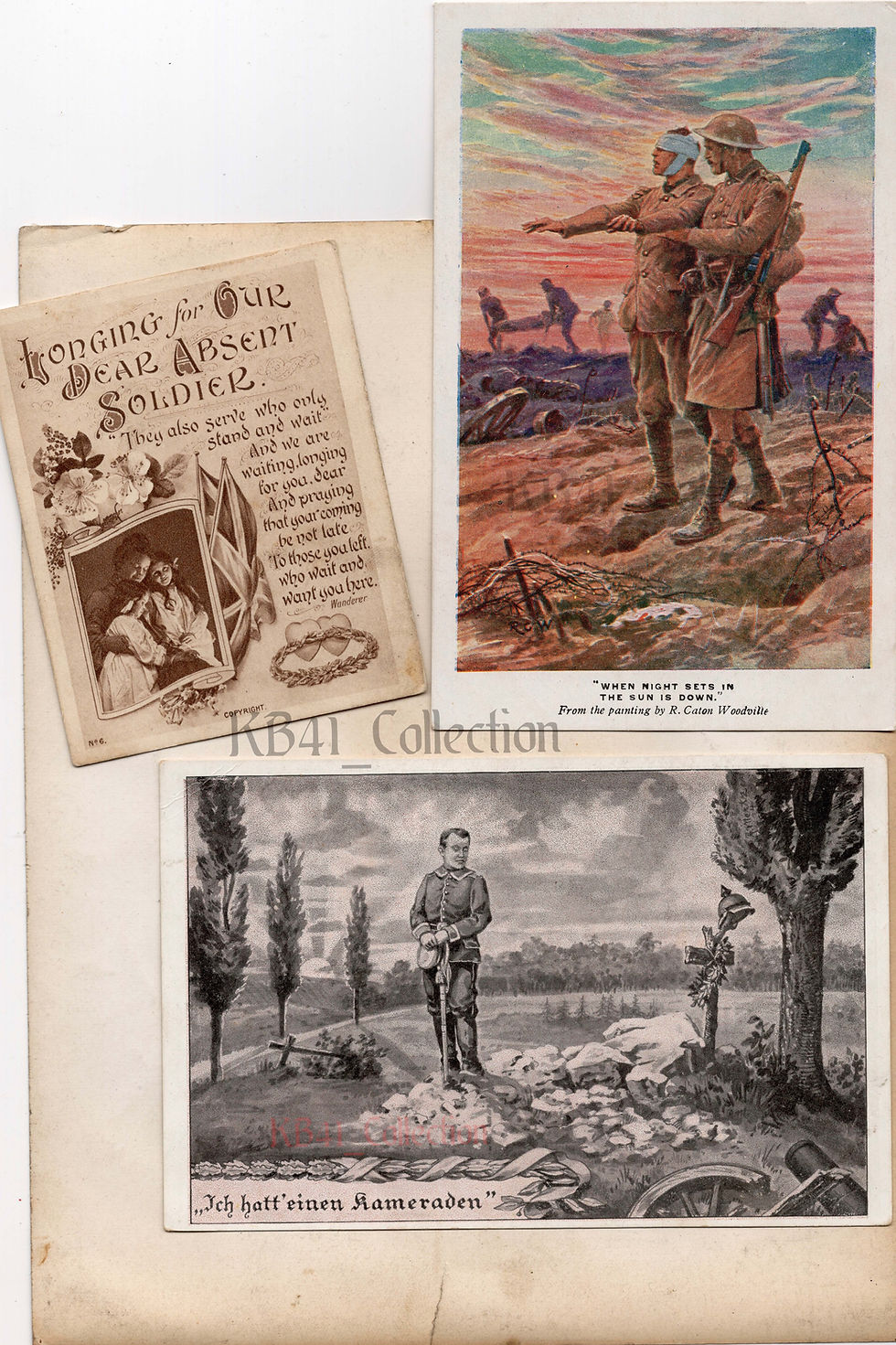
The three cards here show Two Original Postcards and One “Midget Card” which universally are from the First World War Period and are in themes surrounding the conflict.
The Top postcard shows British Soliders Helping the Wounded after a battle across a scattered and war torn landscape, sights that many of us have never seen, the horrors of war that are limited to the Photographs in which we collect. The postcard is titled “ When Night Sets In, The Sun Is Down” This is a Painting from a renowned and Famous War Artist Richard Caton Woodville Jr. (1856- 1927) which was published suggested to have been published 1915 to raise money for Two Charities, The First was St Dunstans, which was founded the same year to offer support and more importantly rehabilitation for wounded solders and Servicemen who were blind or blinded as a result of injuries sustains during the conflict. Other proceeds also went to the National Institute for the Blind.
The second and smaller card or “midget card” is a small “Forget me not” or Sweetheart card that often came with magazines such as The Red Letter, a Homefront womens magazine. That was sometimes even sent to those in service. The midget card features a small keepsake that could have been kept in a soliders pocket, which at the time and as is still the same for current serving personel; anything that is sent from lovedones or home would be kept close and have a huge boost to their morale during the darkest periods of Human History.
It bears the words of a poem:
They also serve who only stand and wait"
And we are waiting, longing for you, dear
And praying that your coming be not late
To those you left, who wait and want you here.
— Wanderer
The opening line “They also serve who only stand and wait” also has a connection to blindness as it is a quotation from the final line of a Famous 17th Century Sonnet, wrote by John Milton. Titled “On his Blindness” this sonnet details John Milton and his loss of sight in which he reflects and understands how he is able to still serve god whilst being blind.
The following verses detail how the Loved ones of the Serviceman reading this are longing for their safe and quick return. With a cluster of Allied flags from WW1 which enables the card to be incorporating many more nations in the purpose of the card.
The final Postcard or Postkarte, depicts a lone German Solider, seen reflecting upon a fallen Kameraden. This patriotic postcard shows another card that goes further with its words, The line; “Ich Hatt Einen Kameraden” (I had a Comerade) is the opening line to a German Romantic Poem, wrote in 1809 by Ludwig Uhland, called the “Der Gute Kamerad” (The Good Comerade). This was later set to music in 1825 by Composer Freidrich Silcher.
Ich hatt' einen Kameraden, ( I had a comrade)
Einen bessern findst du nit. ( A better one you will not find)
Die Trommel schlug zum Streite, (The drum beat to battle)
Er ging an meiner Seite (He marched at my side)
In gleichem Schritt und Tritt. ( In the very same pace and step)
Eine Kugel kam geflogen, (A bullet came flying,)
Gilt’s mir oder gilt es dir? (Is it meant for me or for you)
Ihn hat es weggerissen, ( It tore him away,)
Er liegt mir vor den Füßen, (He lies at my feet,)
Als wär’s ein Stück von mir. (As if he were a piece of me)
Will mir die Hand noch reichen, (He still wants to reach out his hand to me,)
Derweil ich eben lad. (While I am reloading my gun.)
Kann dir die Hand nicht geben, (I cannot give you my hand,)
Bleib du im ew’gen Leben (Remain in eternal life)
Mein guter Kamerad! (My good comrade!)
The latter adopted song describes the grief of losing a fellow soldier in battle. The song then went on to become an official part of German military funerals in 1871, Where ever since it remains the standard ceremonial lament played at funerals and remembrance services for the German Armed Forces.
The card details a lone solider looking onward at his fallen Kamerad who now lies buried on a battlefield where his grave is marked by a cross and Picklehaub. A scene that often happened as wartime funerals and burials were a sad common practice.
Whilst this poem goes into much greater detail than the other smaller Allied card they both show that regardless of side that every nation uses the same themes of Comradeship, Sacrifice and Grief to cope with the conflict. All of these cards highlighting the loss of human life during the First World War. Which is why Armistice day or Rememberance day started to comemerate. On the 11th Day of The 11th Hour. We Will Remember Them.
Please see our new social page:


Comments